

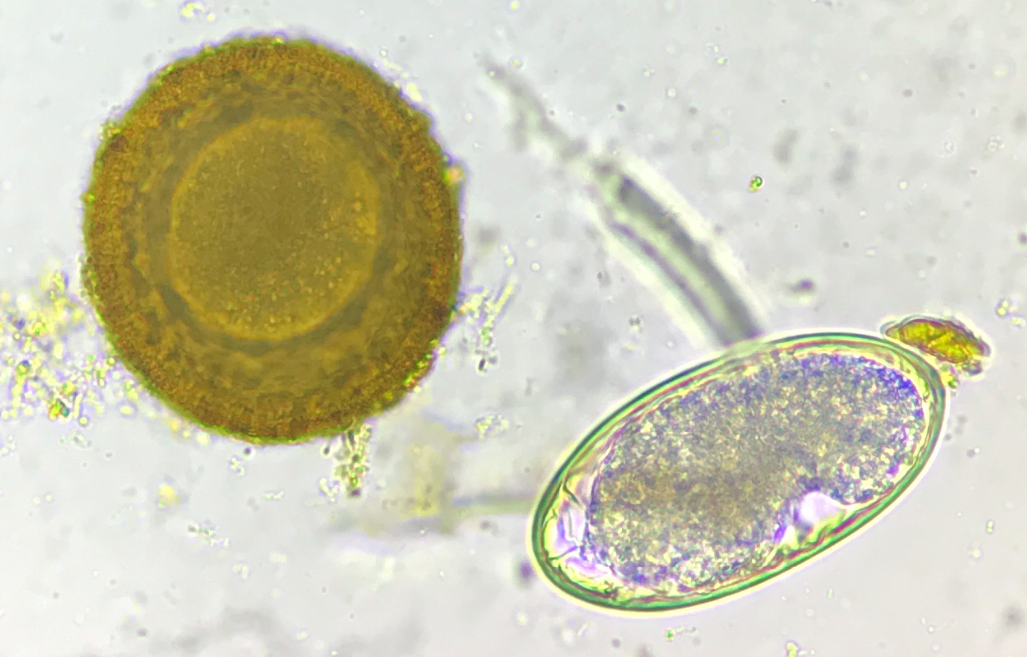
Currently, the most important horses’ parasites are the small Strongyles, Parascaris equorum and Anoplocephala spp.
Deworming at fixed intervals and systematic elimination of all parasites, based on the same pattern is no longer a realistic nor relevant goal.
The alarming growth of resistance against different dewormers is occurring because of:
We Were There:
« Deux chercheuses neuchâteloises viennent de démontrer qu’il n’est pas utile de vermifuger systématiquement tous les chevaux suisses. Seuls 20 à 30 pour cent des animaux ont réellement besoin de traitement… »
–Anne Baecher (PLAY RTS) – Émission du 24 février 2014 « Trop de vermifuges pour les chevaux ».
This pest control strategy respects the nature and needs of each animal, while taking into account the environment in which it evolves. This is called selective deworming.
This approach based on a continuous monitoring of coprological examinations enables reducing deworming frequency in a given horses population. Method’s application primarily concerns horses 3 years old and above. In young horses, monitoring through coprological analysis is important for determining parasite loads and to quickly identify possible resistance.
It has been shown that the parasite load concentrates on only 10 to 20% of a farm’s horses; and these are the animals responsible for parasites’ dispersion in the pastures. Prior examination allows identification and targeting of these individuals within the herd or farm.
Identification of parasite eggs. Sedimentation-Flotation is essential for more difficult-to-detect parasites, such as Anoplocephala spp. eggs.
Adult stages’ quantitative excretion’s exposition (No. of eggs in faeces).
Evaluation of the efficacy of an anthelmintic based on post-treatment egg excretion reduction.
Kaplan RM, Nielsen K. 2010. Equine Veteri- nary Education 22(6): 306-316.
The first year is for monitoring.
Analysis of 4 samples distributed over the year in the following order:
A. The first 2 faeces samples are taken about 6 weeks apart (beginning of the grazing season).
B. The following 2 are taken at an interval of about 3 months.
From the second year and above, we’re in the control years.
Generally, two samples are taken.
Post-treatment (15-17 days) control.This is the resistance test.
Performed only on treated individuals. It allows to assess treatments effectiveness and to identify resistances (resistance test).
Application of FECRT (Fecal Egg Counting Reduction Test) method which demonstrates the effectiveness rate.